
JULY 2024
yet another planning metric acting contrarily
"One final thing", the caller said, "We are asking each of the speakers to tell us which book has most influenced them professionally." The caller is from the University of Canberra. It's a couple decades ago, and they have asked me to speak with three other architects/ urban designers at a forum there.
Ian McHarg's influential book "Design with Nature" was my immediate choice. Piquing our collective interest it turned out that was selected by two of the other speakers; the fourth selected the seminal book "The Image of the City" by Kevin Lynch. As an aside, to this day both books sit on the desk in my study as icons representing key influences in my work. In Design with Nature McHarg wove together with extraordinarily captivating prose conceptual ideas and design exploration and, in doing so, created a thoughtful and exhilarating way to examine and understand our world.
This week comment has increased about the Victorian Government policies for requiring 30% tree canopy in urban areas. Those of us who have worked in Canberra will be familiar with the tree canopy requirement in that city that has been applicable for some time. The contradictions inherent in that policy were apparent, but the relatively low density of built form in Canberra meant that those could be dealt with relatively easily. The higher density of Melbourne, however, will highlight the conflict of what is a well-intended policy with the reality of denser built form and our need to minimise our collective carbon footprint.
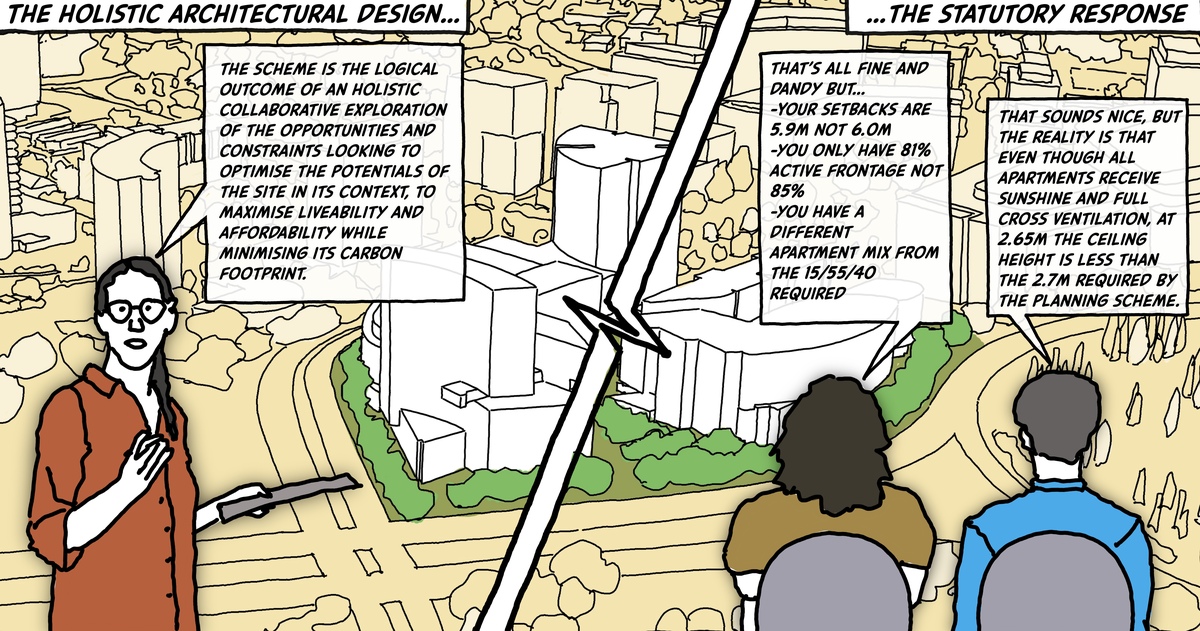
Which is why Design with Nature popped into my head. In the book McHarg deals poetically with the difficulty of comparing value systems. Some things can be priced; many things cannot. McHarg speaks of a hierarchy of social and natural values, and examines those in conjunction with traditional cost-benefit analyses in a way that balances and optimises instead of competing. In doing so he investigates and proposes at an holistic level. By contrast too much planning policy we are required to comply with focuses on detail at the expense of the big picture. We should and would expect big picture strategy to influence and guide the more detailed policies. But too often it doesn't.
The green canopy policy is an example of that myopia. The policy is intended to be beneficial, and often it will be. But…applying those requirements to many urban areas will result in decreased density. That reduction in density will result in increased overall carbon footprint and reduced affordability. We will (hopefully) get some more trees, but as a result we will need to build more roads (inevitably reducing tree canopy), drive cars more and generally burn more fossil fuels. So on the one hand we get increased localised amenity through increased canopy, but on the other hand we worsen climate change and city-wide amenity.
There is an increasing trend towards simplistic metrics being mandated by planning schemes instead of authorities doing the hard work to arrive at planning principles which then form the context for more detailed design examinations at site scale. The arbitrary imposition of metrics often divorced from the reality and possibilities of individual sites, and the frustration of having to deal with those, can easily result in designs paying lip service to those requirements rather than enthusiastically embracing potentials to benefit society.
Design with Nature was first published in 1969 following years of work by McHarg and his collaborators. Fifty-five years later in an increasingly complex world his approach to examine and then optimise those complexities are more relevant than ever. It is a great pity therefore that our statutory obligations ignore the benefits to society of holistic planning, and instead are becoming increasingly simplistic.